Wellness center marketing comes down to five things: a website that explains each service in plain language and lets people book it, a Google Business Profile that shows up when someone nearby searches, health claims you can back up, real photos and video of your space, and a plan that turns a first visit into a membership.
We're an Atlanta marketing agency that builds websites, runs SEO and Google Ads, and shoots photo and video for businesses of all kinds, including healthcare practices like Oculare, an optometry practice and eyewear boutique. We haven't marketed a wellness center yet, so this is how we would approach one, based on how people search for care and what the ad platforms and regulators expect.
Know What Kind of Wellness Center You Are
"Wellness center" covers very different businesses, and each one is searched for in its own words. Name yours clearly on your site and your Business Profile.
| Type | What people search for | What they want to know first |
|---|---|---|
| Med spa | Botox, fillers, laser, facials near me | Who performs the treatment and the price |
| Biohacking and longevity center | Red light therapy, cold plunge, hyperbaric, longevity testing | What the technology does and how a session works |
| Recovery and performance studio | Sports recovery, compression, sauna near me | Session length, memberships and hours |
| Holistic or functional health | Functional medicine, nutrition coaching | The practitioner's training and the first visit |
| IV and hydration clinic | IV therapy near me | Who administers it, safety and price |
Some centers bring several of these together, which gives clients more reasons to come back. Soterra (opens in a new tab) is a great example: a biohacking and longevity wellness center that combines health and performance testing, advanced wellness technology, movement, recovery and expert guidance under one roof.
A Website That Explains Each Service and Books It
Most people find a wellness center on a phone, often after hearing about a treatment from a friend or a podcast. They want answers before they book.
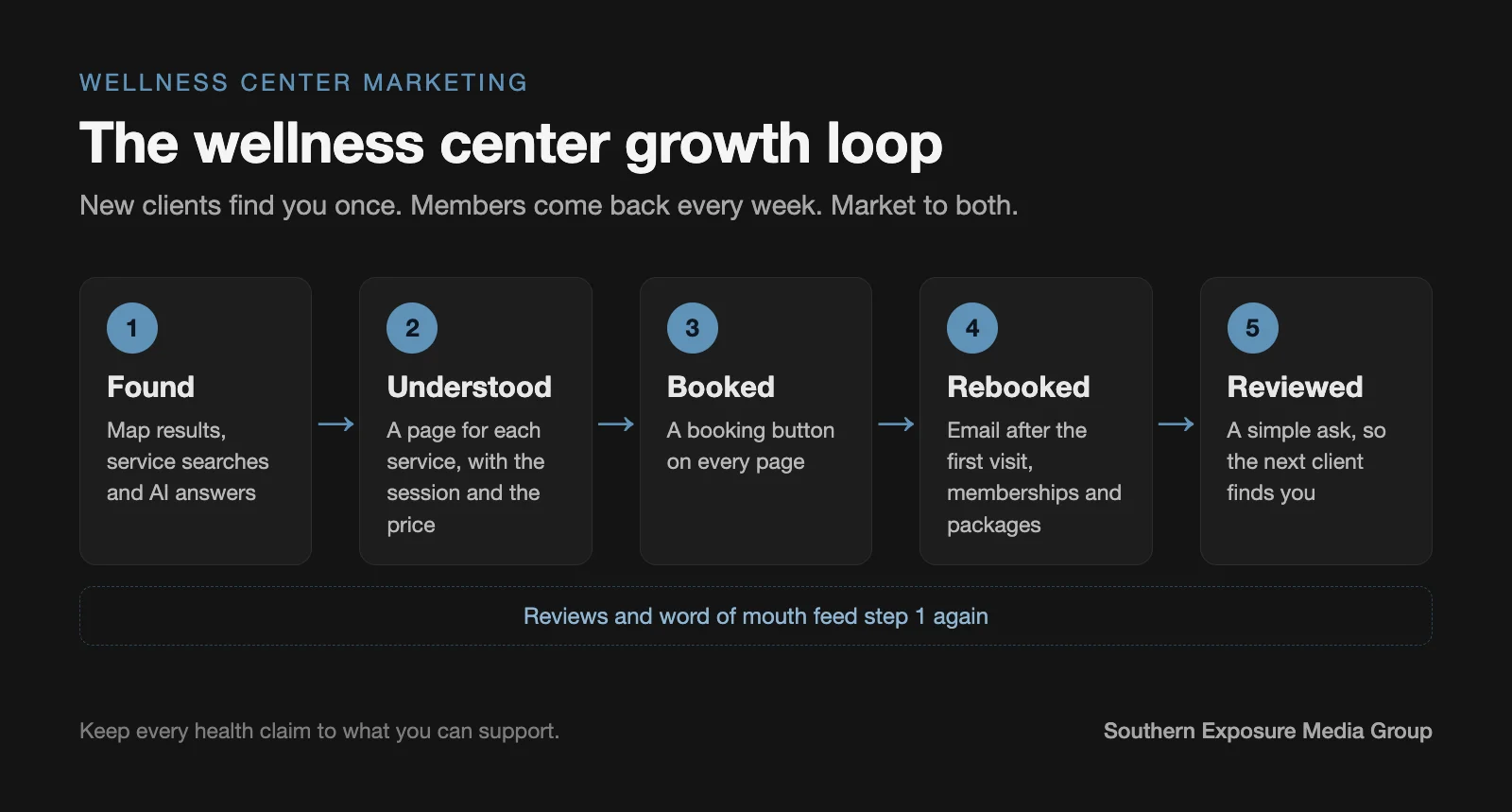
One page per service. Red light therapy, cold plunge, infrared sauna, IV therapy and body composition testing should each have a page. Open with a plain answer: what it is, who it's for, how long a session takes, what it feels like and what it costs.
Booking on every page. Put a "Book a session" button at the top of each service page, connected to the booking tool you already use. If first-time visitors need an intake form or a consultation, say so before they click.
Memberships and packages, explained. A clear page that compares memberships, packages and single sessions does more selling than any ad.
Answer the questions people ask. "Is red light therapy safe?" and "How often should I do a cold plunge?" are searched every day. Short, careful answers on your pages are also what Google's AI Overviews and ChatGPT quote. Our guide to local SEO for small businesses covers the basics.

Google Business Profile and Local Search
When someone searches "wellness center near me" or "cold plunge near me," the map results come first. That's where most new clients will find you.
- Pick the most specific primary category that fits, then add secondary categories for your main services. Google's guidelines for representing your business (opens in a new tab) say the name must be your real business name, so don't stuff services into it.
- List each service with a short description and a price where you can.
- Add real photos every month: the space, the equipment, the team.
- Post your hours and holiday hours, and keep them the same everywhere your business is listed.
- Ask every happy client for a review. Our guide to getting more Google reviews covers how to ask without breaking Google's rules.
Health Claims: Say What You Can Back Up
Health claims are the part of wellness marketing to handle with the most care. Words like "detox," "boosts immunity," "reverses aging" and "cures" are claims, and claims need support.
The FTC's health products compliance guidance (opens in a new tab) says health claims must be backed by competent and reliable scientific evidence. The ad platforms add their own rules: Google's healthcare and medicines policy (opens in a new tab) restricts some treatments and claims, and Meta's health and wellness ad standards (opens in a new tab) limit before-and-after images and claims about bodies.
This isn't legal advice. If you offer medical services such as IV therapy or hormone treatment, check your state's rules and your medical director's guidance before you advertise.
Memberships, Packages and the Second Visit
A wellness center grows on repeat visits. Most of the marketing work happens after the first session.
- Offer a clear first-visit path: an intro session or a first-month offer, then a simple next step.
- Follow up by email within a day, with what to expect next and how to book again. Our guide to email marketing for small businesses explains how to set it up.
- Send members something useful every month: new services, schedule changes and a short note from your team.
- Make it easy to pause a membership instead of cancelling it.
Photos and Video of Your Real Space
People are paying to spend time in your space, so show it. Stock photos of a stranger in a robe tell them nothing. Shoot the rooms, the equipment, your team and real sessions with written consent. Short videos of how a session works are some of the most useful content a wellness center can post, on its site and on social media.
Our own photo and video team in Atlanta has made more than 2,000 videos for 73 brands. For Oculare, one shoot gave the practice a film, photos for its website and posts for social media.
Paid Ads That Fit the Rules
Google Ads works well for searches with clear intent, like "IV therapy near me" or "infrared sauna Atlanta." Build a campaign for each main service, send each ad to that service's page and track bookings, not just clicks. Some health topics limit who you can target: Google's personalized advertising policy (opens in a new tab) doesn't allow targeting people based on health conditions. Meta ads can work for intro offers, as long as the ad shows the space and the experience rather than a promise about results.
Track Bookings Without Leaking Health Data
Track which pages, ads and searches lead to bookings, so you know where to spend. If your center is a HIPAA-covered healthcare provider, be careful about what your analytics and ad tags collect. HHS has published guidance on online tracking technologies (opens in a new tab) that explains the risks of sending health information to third parties. Even if HIPAA doesn't apply to you, keep health details out of ad platforms.
What Wellness Center Marketing Costs
Our websites run $8,000 to $25,000, and a site with custom booking or membership tools starts at $25,000. Local SEO, AEO and GEO run $1,500 to $4,000 a month, and Google Ads management runs $1,000 to $2,500 a month plus a $750 to $1,500 setup fee, with ad spend paid separately. Social media with a monthly shoot day runs $4,000 to $8,000 a month, and email marketing $1,500 to $3,000 a month.
- Local SEO, AEO and GEO$1,500 to $4,000
- Google Ads management$1,000 to $2,500
- Email marketing$1,500 to $3,000
- Social media with a monthly shoot$4,000 to $8,000
Southern Exposure Media Group's own ranges, 2026. Ad spend is separate.
Your Wellness Center Marketing Checklist
- Name what kind of wellness center you are, on your site and your Business Profile.
- Give every service its own page with what it is, who it's for, a session walkthrough and a price.
- Put a booking button on every page.
- Keep every health claim to what you can support.
- Add real photos of your space and team to your site and profile every month.
- Ask every happy client for a review.
- Follow up by email after the first visit, and make memberships easy to start and pause.
- Track bookings by source, and keep health details out of ad platforms.